
I Thought 2026 Would Be My Year of Healing
Then I landed in the ER, and learned I wasn’t done letting go


Hello Lovelies,
For a fleeting moment, I thought I would devote this year to healing.
Most people won’t make such a big commitment, even to their own health and well-being, because they believe they're too busy. Even if they acquire a laundry list of symptoms, they still put off self-care, thinking, “This isn’t so bad. I can keep going.” Indeed, people have a fantastic ability to keep pushing themselves even through what can be a life-altering diagnosis like cancer.
I know. For a good part of my life, I have been the worst offender.
But I became excited about a year of healing because I thought I could accomplish it through micro-actions. I have trouble with consistency—don’t we all when it comes to habits? The average New Year’s resolutions last less than four months, according to a Forbes Health survey, with many people giving them up in the first or second month of the year.
Could the solution be tiny healing steps? Maybe. But as it turned out, I wasn’t finished with letting go, the theme I had chosen for 2025.
Everything Changes and Changes Again
On Tuesday, December 22, I woke up around 4:30 am with sensations radiating from all around the top of my headache—not precisely a headache, but what? Then I had a visual aura (shimmering lights) that lasted around the usual thirty minutes. I’ve had them for decades, but lately (after that Moderna COVID-19 shot) more frequently.
Did this warrant calling the paramedics?
I waited three hours with no change to my symptoms. Then, with my neighbor's encouragement, I made the call.
My vitals checked out, my EKG was good, and I wasn’t having symptoms of a stroke. Still, the paramedics thought I should have these symptoms checked out at the Emergency Room.
The 45-minute ride felt like a movie, watching the sea of parted cars out the back window. I could barely hear the blaring alarm inside the ambulance, a relief for someone with sound sensitivity.
This was my first visit to an Emergency Room since my early twenties, and I wasn’t sure what to expect.
Freezing, the ER felt like a cold hell realm, as featured in Tibetan Buddhism. There are eight, with terrifying names like the Hell of Blisters, the Hell of Clenched Teeth, and the Hell of Lotus-Like Cracks.
I had two thin blankets, but not heated ones, for the first few hours. It didn’t occur to me to ask. The nurse, in his haste, hadn’t even given me a call button. Once he took my vitals, he was gone for hours at a time.
Indeed, half the ER personnel seemed dissociated. I couldn’t blame them, given the noisy, chaotic, and disturbing environment. I tucked my earplugs into my ears. Fortunately, I always keep a pair in my bag. Then, I waited—for what I did not know.
A doctor spoke with me briefly, and eventually I found out that a CT scan had been ordered. A small chalkboard on the wall indicated you might have to wait several hours for lab tests and any type of imaging.
Cold and alone, I continued to wait. During one of my trips to the bathroom, I discovered beds in the hallway had filled up with patients. How lucky I was to have a room. My head symptoms had subsided during the ambulance ride, but I now had an intense headache along with a return of the original sensations.
When it finally happened, the CT scan was quick, and the technician kind-hearted. Back to waiting, I periodically updated my sisters and my neighbor via text messages. Then I’d quickly switch the phone back to “airplane mode” to preserve the battery. I managed to acquire heated blankets, too, after one of my regular ones disappeared after the CT scan.
During one of my many pee trips, I saw a man with scabs all over his legs in an aisle bed. A baby cried endlessly in a room near mine. If nothing else, a trip to the ER can arouse compassion, a quality so needed in this world. Whatever my problem, I reasoned, I wasn’t suffering nearly as much as all these other people.
Finally, my rarely seen nurse suddenly appeared and told me, “You need to have an MRI.”
”Why?” I asked.
”They found something concerning on the CT scan.”
As someone prone to off-the-chart anxiety since an earlier medical emergency in April 2025, I felt impressed by the degree of equanimity and rationality I exhibited in the ER. But I don’t like MRIs and asked the nurse to request a dose of valium for me.
And to be honest, after hearing the words “something concerning,” I teared up for a few moments. You're not allowed to eat or drink in the ER in case you end up needing emergency surgery. Would that happen to me? What would the future hold?
But I pulled myself out of that momentary fear when I reassured my sisters by text, “Let’s just wait and see the MRI results. It might be nothing.” I know that can be true from experience.
Liberation
”Quick, get in the other bed,” the MRI technician instructed. “We only have ten minutes. Otherwise, I won’t be able to do the scan until this evening. We’re just doing your head.”
Then he unexpectedly placed a covering over my eyes, and into the tube my head went.
Despite my sensitivity to sound, I decided to go with the loud clanging of the MRI, imagining I was dancing to booming concert music. Interestingly, my head felt better afterward—at least for a short while.
Back to waiting again, but not for hours. Maybe twenty minutes later, I received a text from the hospital saying I was being discharged. That sounded like good news, but it would be another twenty minutes before the doctor came in to tell me the MRI results.
”You have a small, benign brain tumor—a meningioma. Your symptoms are probably just from migraine. But you should see a neurologist as soon as possible. I’m sending your scans to Dr. Gonzalez.”
Twenty minutes later, a nurse came in and unhooked me. Finally liberated, I took two Tylenol to ease my intense headache, threw on my clothes, and ordered a Lyft.
I had spent about seven hours in the Emergency Room without food or water, most of the time, freezing my fanny off.
Brain Tumor News
A meningioma is a tumor that sits in the meninges, the protective membranes that line the skull and the vertebral canal. Depending on its size and location in the brain, it can cause symptoms such as headaches, convulsions, and memory problems or not have any impact at all.
Meningiomas are the most common type of brain tumor. Most (not all) are benign, meaning not cancerous. Because this type of brain tumor grows slowly, it’s often discovered as an incidental finding later in life when you receive an MRI for another reason.
I felt like the ER doctor had given me a clean bill of health. So, I didn’t madly search for information about meningiomas. Indeed, I became pretty adept at making jokes about my own brain tumor. That might have been one of the stages of grief—denial. But it worked well to keep me from slipping into anxiety.
My light-hearted attitude only lasted until one of my regular doctors scared me with her intense concern and talk about gamma ray knife radiation.
”You’ve got to see the neurologist right away. Call them right away. Get on a list for cancelled appointments right away,” she demanded.
Her worry prompted me to do my own research. I learned enough about meningiomas to make me nervous. Brain surgery is typically the first line of treatment, not radiation. But brain surgery has risks. Removing a meningioma can have adverse effects.
By the time my neurology appointment arrived, two weeks after my ER visit, I couldn’t drive. My headache/migraine symptoms had worsened. The wonderful friend who drove me kept me calm with his mellow vibe.
The neurologist confirmed what the ER doctor had told me—my brain tumor is no big deal and absolutely not causing my symptoms. He pointed to migraines, which can manifest in many ways beyond the classic one-sided, pulsating temple pain. The neurologist also suggested I may have cervical stenosis, accounting for my neck and shoulder pain.
Most importantly, I learned that people with migraines should not take common pain relievers like Acetaminophen or Ibuprofen more than 2-3 times a week or 15 days a month, according to the American Headache Foundation. Doing so can lead to a Medication Overuse Headache.
Before this, I had managed migraines and visual auras by avoiding my triggers. Medication overuse had never been a consideration for me.
But the last few months, I’d been using Acetaminophen far more generously due to constant pain in one part or another (although never more than the amount instructed on the bottle). I didn’t get a chance to discuss this with the neurologist, but since reducing my use of Acetaminophen, my symptoms have gradually improved.
Happy Ending?
You could call this a happy ending, but I don’t believe we’re here for happy endings. As Pema Chödrön once famously said, things get resolved only to fall apart again. Change is the nature of life.
But of course, enjoy whatever happiness comes your way and cultivate inner joy so you don’t have to depend on externals.
I saw this entire experience as a brief but intense conversation with my mortality. It has strengthened my commitment to slowing down, reducing stress while working, and spending more time in meditation and spiritual study.
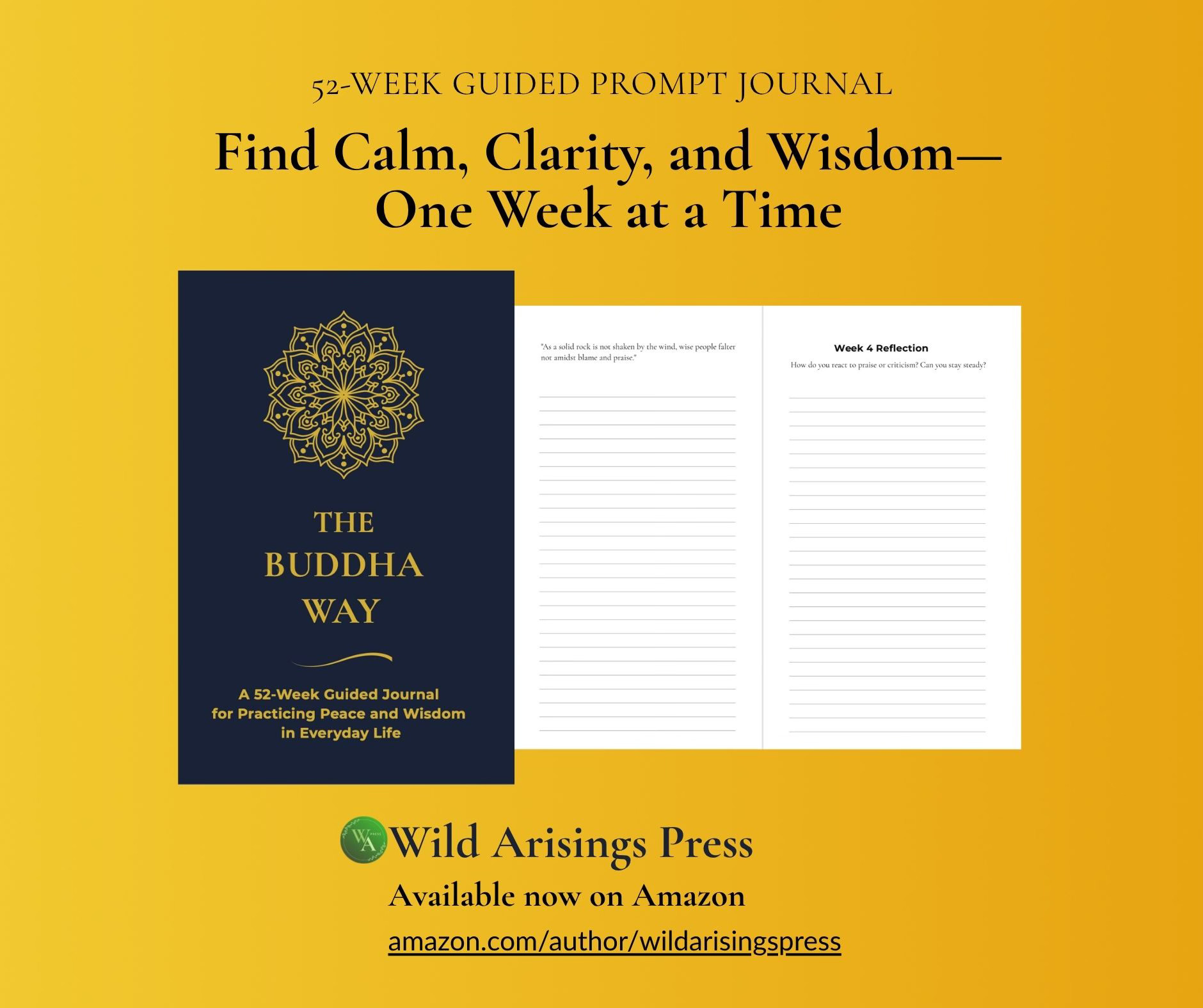
That’s why, as previously announced, in 2026, I’ll be posting my e-letters and articles just twice a month here on my Wild Arisings Substack. Once I have a chance to set it up, paid subscribers will receive a PDF copy of my recently published journal, The Buddha Way: A 52-Week Guided Journal for Practicing Peace and Wisdom in Everyday Life.
Will 2026 become my “year of healing?” I have some new micro-habits on my list to enact, especially ones to help with anxiety. But I sense I have more letting go to do before I commit to a year of healing, if I ever do.
In the meantime, I’m contemplating a question I received from the spiritual teacher Suzanne Marie, which I’ve modified to resonate for me:
”The experience of pain doesn’t mean there’s an I.”
Reflecting on this prompt can help one embrace the Buddhist concept of no-self—no easy feat, but essential to spiritual awakening. When I heard Suzanne’s original question, I felt an “aha.”
If that prompt seems too abstract, just focus on kindness—nourish yourself while you also nurture another.
Until Next Time
It’s been two weeks since my ER visit and the day I stopped taking pain relievers. I feel so much better. I still have some shoulder and back pain, but acupuncture helps with that.
As always, I’m so grateful for your presence and support. Every ❤️, comment, and share helps my articles reach more people. So please keep them coming, and know how blessed I feel by your presence and generosity.
Until next time, stay safe, be happy, and try a few more random acts of kindness. Sending you all my love and best wishes.
xo Sandra
Invest in yourself. Join 4,000+ beautiful souls and become a paid or free subscriber. You’ll receive weekly caring advice on calming your mind, healing your heart, and connecting with your inner wisdom from a long-time mindfulness practitioner.
Thank you! ❤️
P.S. Create a quiet weekly ritual of reflection with my recently published The Buddha Way, a guided mindfulness journal featuring 52 quotes and prompts for inner peace. A calming companion for anyone who loves journaling, meditation, or starting the new year with intention.
Do you know how to close out a year or what?! 😉 I am so sorry you went through all of this, Sandra! The fact that you could stay relatively calm over your 7 hours in the hospital speaks volumes of the healing work you have done. I hope you recognize that. 💝
Oh jeeze Sandra, this sounds like a brutal experience. And as ever, you are treating it as a learning. I'm in awe of you x